Wednesday, 16 May 2012

Wednesday, 9 May 2012

Russell's Curio Corner #2


For this Curio I thought I'd show some of the work that came about during the process of illustrating the Word Hoard vault.

After reading Phil's Galdr Song, I began researching Viking burial vaults.  For the first couple of sketches I adhered to a literal representation, maintaining a distance from the more fantastic representations (D&D, Elder Scrolls, LOTR) of vaults and caves.


But this ultimately failed to do justice to the scale of the poetry.  I suppose historically, the gravity of emotion mythicisized  human experience.  The empiricist of the Enlightenment would shine a light into a dark recess and measure the dimensions whereas the primitive man (oxymoron?) would cast his gods and devils and keep a safe distance.  When our ancestors walked into a forest in the blackest night, the darkness concealed dragons and beasties that only the quickening pulse and peripheral vision could sense.  And since the concrete is deprived of the abstract it can be studied and rendered.  Therefore, everything that can't be seen must be grander than that which can.  Our Viking man builds a tomb out of stone and earth but the spirit of the interred turns it into the gate to Valhalla.  So, with this idea planted in my head came the acceptance of a larger scale.


The throne caught my imagination.  In particular, the word "knotted."  While doodling ideas I proposed an idea to myself, "What if the throne is actually a tree."  So, I wondered, "What kind of tree?"  So, while searching historic trees I found the Pulpit Yew :

...and so I had a precedent.  Then, I decided to use the layering beech as the actual tree because...they're pretty cool looking.  The particular tree, if you're interested in that kind of thing is the beech at Kilravock Castle.


From there it was a matter of sketching and painting and thinking and talking with Phil and re-sketching and re-thinking...


...until voilĂ !  We found something we liked.


Oddly enough, this little sketch came about from a bit of paper taped to my drawing board and desk (my desk doesn't really have a Photoshop-ped cavern in it):


And from this humble little model came the layout for what wound up being the layout for the final painting.


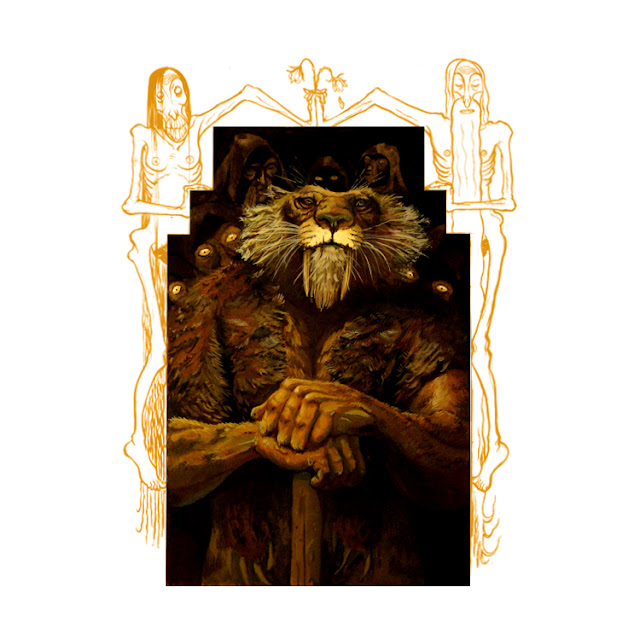
What I like best about working with Phil is the completeness of the world described in the Annals.  It makes setting a scene that much easier because there are so many references that can be drawn from.  All of the statues and carvings in the Galdr Song painting are based on just a handful of characters from the poems.  The same goes for the hoard in the initial sketches: all of the items are to be found in the Annals.  So with that said, as more poems are posted and more of the world is revealed, you should be able to look back and spot a thing here or a person there either somewhere in the background, or in a border, or in the shadows with the dragons and the beasties...


All images copyright their respective owners.

Wednesday, 2 May 2012

Wednesday, 25 April 2012

The Ode Less Travelled


This is one of the greatest books I've ever read. I got it a couple of years ago, and it did what it says on the cover; it unlocked the poet within me. It taught me about prosody - the art and craft of versification.
The thing I've always most enjoyed is the craft, the nut-and-bolts, of poetry writing. It's great to come up with stories and ideas, but the deepest pleasure for me comes from fitting those ideas into a form, with the rules and limitations that come with it. And often, the greater the limitations, the more fun it is.
It's all about pushing against the boundaries of the form, without breaking them. Some of the forms I learned about in the book are very limiting. The Sestina for instance. I won't try to explain it here. It's complicated. As it says in the book, the best way to understand it is to write one, but if you're interested, check it out: http://en.wikipedia.org/wiki/Sestina (next week's post will be a Sestina).
'Old Moon', the first poem in this blog, is a Rondeau Redouble. 'Galdr Song' is composed of five sonnets. This marvellous book taught me how to write them.
I'd been penning poems for many years before I got the book, but reading it awoke in me my true goal;
to investigate the technology of poetry, to be a craftsman.
Of course, another wonderful thing about The Ode Less Travelled, is that it's written by Stephen Fry.
One couldn't wish for a more genial teacher. His mellifluous tones spill from every page.
It goes with me everywhere. I highly recommend it. Hooray for Stephen Fry!

Wednesday, 18 April 2012

Wednesday, 11 April 2012

Russell's Curio Corner #1

Howdy all!

Just a quick introduction from me:  I do the drawings and paintings. 

About 13 times in the course of a year it is my duty to talk a bit about the picture-y side of the Annals.  The whole process starts with Phil sending me a poem, either finished or un.  Often, he’ll also give me a few supporting descriptions of this or that, but a lot of the pictorial direction is derived directly from the text.  Often, I’ll have to look stuff up, read a bit of history and look at a bit of art.  Then, I whip up a slew of sketches and send them Phil’s way.  Then, we talk a bit about the sketches and I shoot out a another slew of sketches and little by little I get down to finished drawings.  I’m hoping that through my annual 13 posts, I’ll be able to share some sketches, some research, some process, some of the stuff you wouldn’t get to see if you were only given a polished and edited version of the work.  I think the process is quite interesting and sometimes, some of the early, unused sketches are interesting on their own. 

I’ll also do my best to help answer any questions people may have.  Since I do a whole lot of research I stumble across a whole lot of interesting things and often, they aren’t directly relevant to what is going on at the time, but if I find something really really interesting and can’t justify it in the work itself, I might just throw it in here…out of interest. 

Well, without any further ado:

Sutton Hoo


I'll save some of the sketches for a little later (sorry).  Most of the sketches I'd like to share might give a few details away earlier than we'd like, so I'll talk about the research side of designing the banner up there at the top.

Oseberg


Now, those of you who hail from the British Isles are probably aware of the finds at Sutton Hoo (and let's not forget our Norwegian friends!  I've used the Oseberg burial as well), but there may be a few of you who would respond, "Sutton who?"  Well, one of the wonderful resources I continue to draw from is a great little book about Viking burial finds (predominantly Sutton Hoo, in Suffolk, (I found the little gem in a charity shop in Chichester for 50p, the book that is)).   Quite a bit of the style of design has made its way into almost everything I've drawn/designed for Phil's poems.  So, I welcome those of you who don't know about Sutton Hoo or Oseberg, or would just like to revisit the info at the wonderful Wikipedia.

(The copyright to all photos belong to their respective owners.)